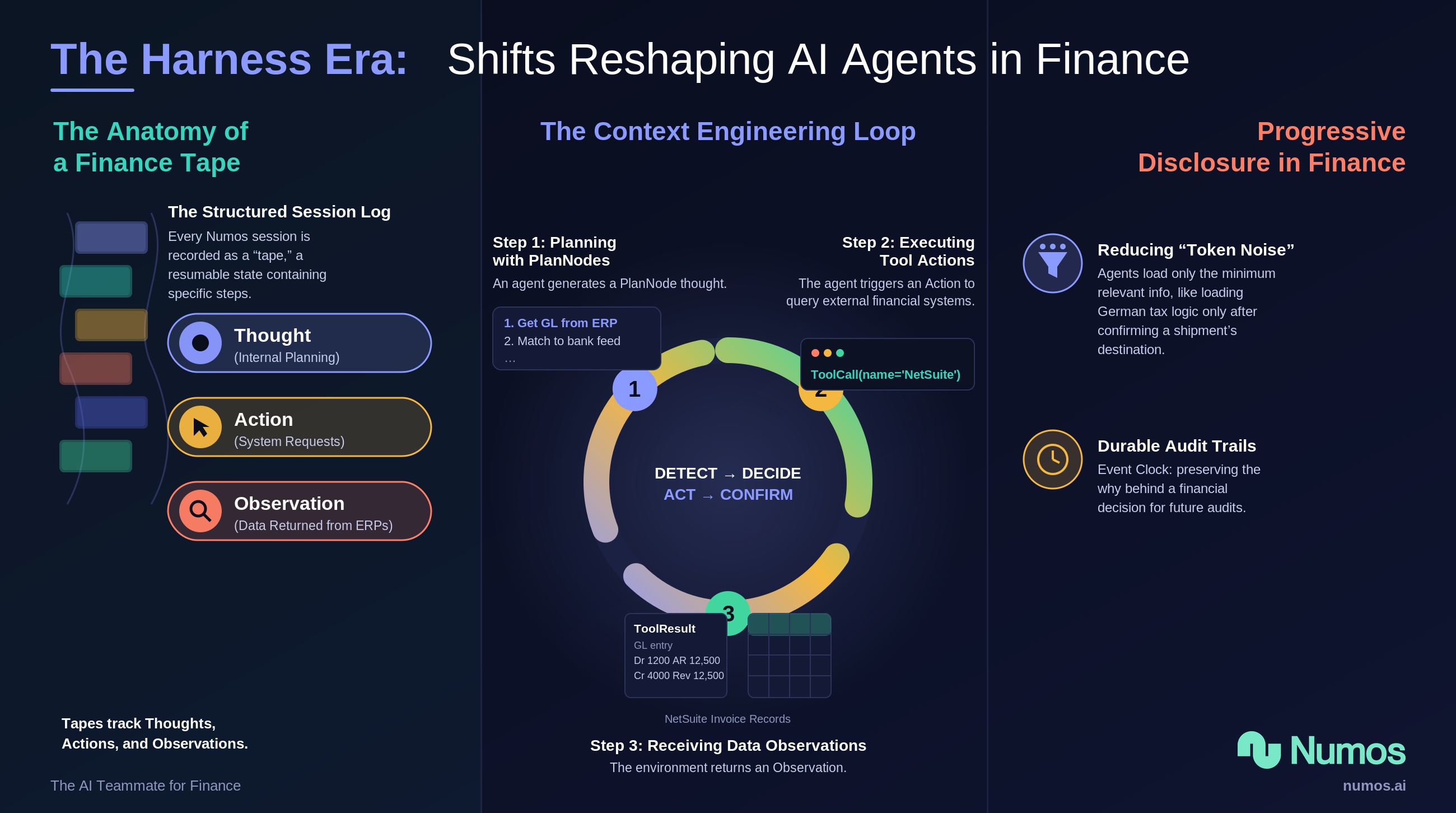
Finance teams have spent billions building systems that record exactly what is true right now: the current GL balance, the posted journal entry, the "Paid" status of an invoice, the closed period. What almost no system captures is why those numbers changed. Why was that accrual booked at $40K instead of $52K? Why did the controller override the auto-match on that bank line? Why did AR write off that receivable instead of escalating?
That reasoning lives in human heads and gets reconstructed on demand in a Slack thread with the controller, a footnote in a workpaper, an email the night before the board deck is due. The result is a “Fragmentation Tax”: the cost of manually re-stitching context that the ERP, the bank feed, and the procurement tool never captured together. Now we're asking AI agents to exercise judgment over close, AP, AR, and FP&A without access to that precedent, like asking an auditor to sign off having seen the final numbers but never the support.
These are the five shifts that decide whether an AI teammate for finance actually works.
1. Deep Financial Context is the New Data Platform
The next durable advantage in finance AI isn't "adding a copilot" to your FP&A suite. It's building a deep financial context layer.
Generic agents fail in finance because they retrieve snippets. A finance agent needs grounded, reconciled, cross-system truth: the GL tied to the sub-ledger tied to the bank feed tied to supplier, customer, and counterparty data . At Numos, the integration layer across finance tools such as NetSuite, Workday, Stripe, Ramp, Salesforce, and banking doesn't exist to move data, it builds the context the agents reason over, recording process reality: which accrual policy applied last quarter, how a vendor's invoices have historically been coded.
Anyone can use the same frontier model and get the same intelligence. What they can't replicate is how your close actually unfolds, how your team treats a disputed receivable, how your controllers handle a variance threshold. Without that, "explain every variance in seconds" is just pattern-matching on numbers the agent can't trust.
2. The "How" is More Valuable Than the "Why"
It's tempting to model human intent of the "Why" when automating finance. But the "Why" rarely survives in a durable format. The "How" leaves a rich digital trail across the systems where finance work happens: ERP postings, bank syncs, the controller's Slack thread, the AP inbox. By tracking those discrete, timestamped actions like a bank line matched, a journal entry drafted, a period sub status flipped, and aggregating them into constructs like "month-end reconciliation" or "AR collections cycle," agents learn the conditions under which a close step proceeds, pauses, or escalates without anyone writing the SOP down.
3. Progressive Disclosure: Why "Less" is Actually "More"
There's a paradox in agent design: as context windows grow, accuracy often declines, because irrelevant tokens compete for the model's limited attention and in finance, the wrong token in scope is how you get a confidently wrong number.
The answer is “Progressive Disclosure”: give the agent only the minimum, high-signal context exactly when it becomes relevant. An agent triaging an AP invoice doesn't need the intercompany elimination policy the moment the invoice arrives it's noise until the entity and currency are identified. This shifts the paradigm from rigid flows to context engineering, where your routing policies, accrual rules, and approval thresholds are no longer hardcoded decision trees but modular blocks of context, surfaced only when their triggers are met.
4. Tapes are Durable Audit Assets, Not Just Logs
For years, system logs were ephemeral telemetry, discarded once a bug is fixed. In finance, where a wrong journal entry doesn't throw a compile error but surfaces in an audit six months later, this is being inverted.
At Numos, every agent run produces a tape: a typed, structured trace of the prompts it received, the reasoning it performed, the tools it called, the financial data it observed, and the actions it returned. Unlike logs, tape isn't a side effect of execution, it is the agent's state, so a workflow can be paused, resumed, replayed, or audited from a single primitive.
The consequence is twofold. First, audit-readiness comes for free: the Tape produces plain-language documentation a controller can read without pinging engineering. Second, the same trace that ran in production becomes the unit you learn from:
The tape is the episode. A finance user's approval is the label. A verifier is a function from tape to score.
This collapses observability, evaluation, and improvement into one object. Approved Tapes can be replayed through candidate prompts to compare them head-to-head, filtered into datasets that sharpen the agents on your chart of accounts, or scored by domain verifiers without leaving the format the agent already runs in. Business reasoning itself becomes a first-class asset and in finance, that asset is also your audit trail.
5. Reasoning and Permission Are Separate Systems
In finance, authorization is existential. Finance agents must treat permission as a primitive, not a prompt instruction.
The model decides what it wants to do. A separate, deterministic layer decides whether it's allowed to. At Numos that means backend role based access control on every endpoint, tenant scoping enforced at the data-access layer rather than in the prompt, and audit trails on every security-relevant event. A jailbroken model cannot override the authorization layer, because that layer never asks the model for permission, which maps one-to-one with what SOC 2 auditors expect to see.
The same separation governs generation and verification. The agent drafting a journal entry is not the agent that checks it against the chart-of-accounts policy, the period's accruals, and historical vendor behavior. Every action passes through verification before it touches a system of record. The security boundary is no longer just about who can see a file, it's about what can flow into an agent's reasoning, and what reasoning is allowed to become an action.
Conclusion: Modeling Your Financial Physics
We're moving from "models that draft journal entries" toward financial intelligence that compounds. The path is through building a better model of your own finance org: how your close unfolds, how your variances get explained, how your escalations propagate under deadline pressure.
If your finance org's reasoning were captured on Tape today, would it be a blueprint for a self-improving close or tribal knowledge that is about to be lost to the fragmentation tax? The answer will define who wins the agent era in finance.
References